When people hear the word “monkey”, they often think of the chimpanzee, which is actually an ape. But monkeys come in many shapes and forms. They’re not just different-looking iterations of the same thing. They differ in their behaviour and adaptations too.
Because we’re viewed as superior, I think a lot of people don’t really appreciate the differences between other primates, grouping them all under this “animal” umbrella. It’s true that they’re all animals, but it’s so cool how different they are, while humans are more or less the same. Of course, we’re comparing many species with just one—ourselves. But even when we notice their different appearances, I think we underestimate how differently they live.
I hadn’t realised that monkeys in the Americas belonged to a different evolutionary branch from those in Africa and Asia. New World monkeys are from the Americas. Marmosets are tiny and adapted to feeding on tree gums and sap. Howler monkeys make themselves known through the forest with haunting, almost screaming, gurgling calls. Some New World monkeys have prehensile tails, capable of gripping branches—an adaptation to their life in the trees. But not all of them do. Marmosets, for example, use their tails for balance rather than grasping.
Old World monkeys are from Africa and Asia. Baboons spend much of their time on the ground, while geladas are adapted to eating grass. Geladas even have highly opposable thumbs and precise finger movements that help them pluck it. These are very different ways of living, even within the same broad evolutionary group.
The nostril part strikes me most. Old World monkeys generally have downward-facing nostrils, whereas New World monkeys have more widely separated nostrils facing out to the sides. Something so small helps us recognise their different lineages. We don’t have to know an obvious purpose for every difference to learn something from it.
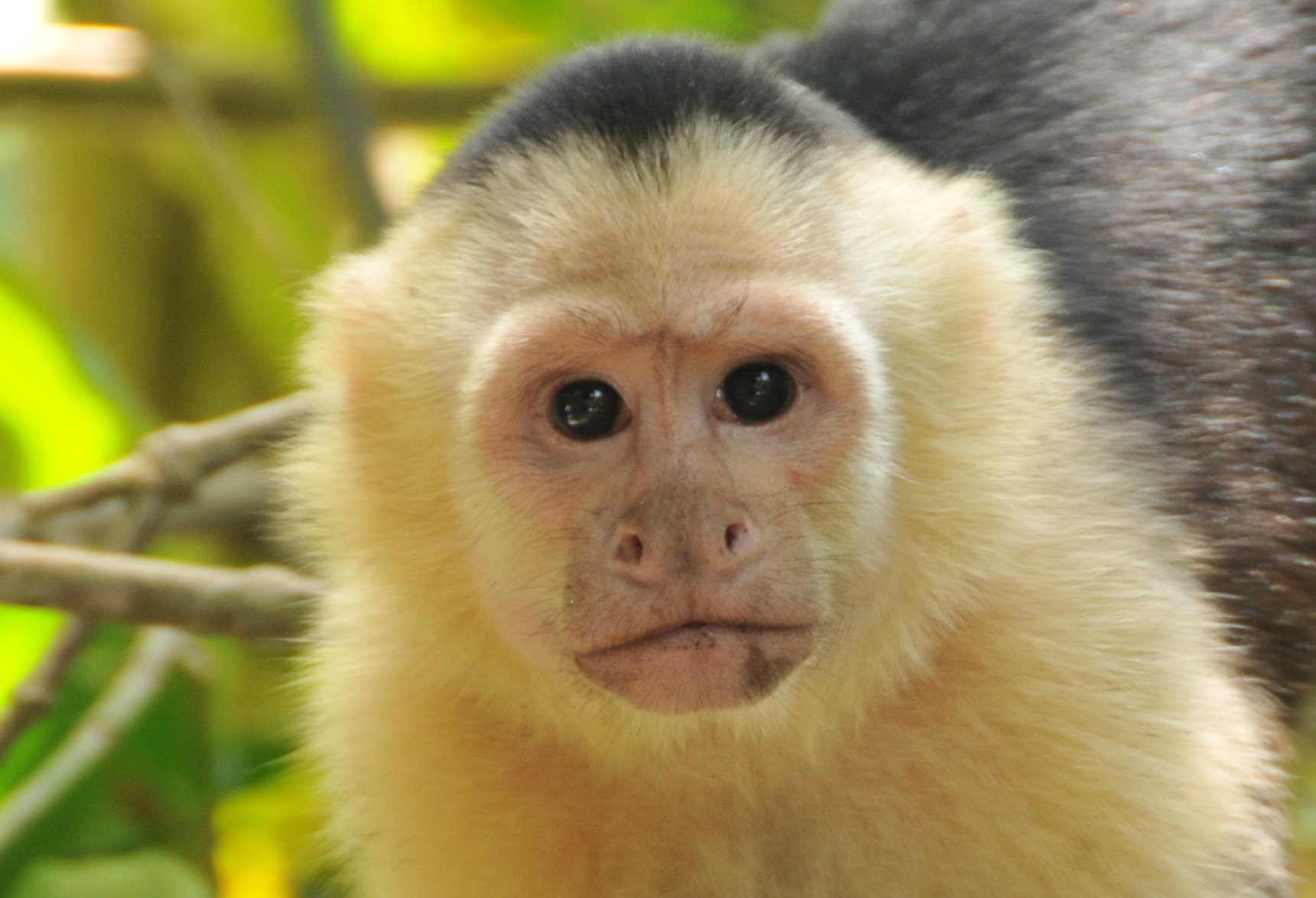 New World · White-faced capuchin
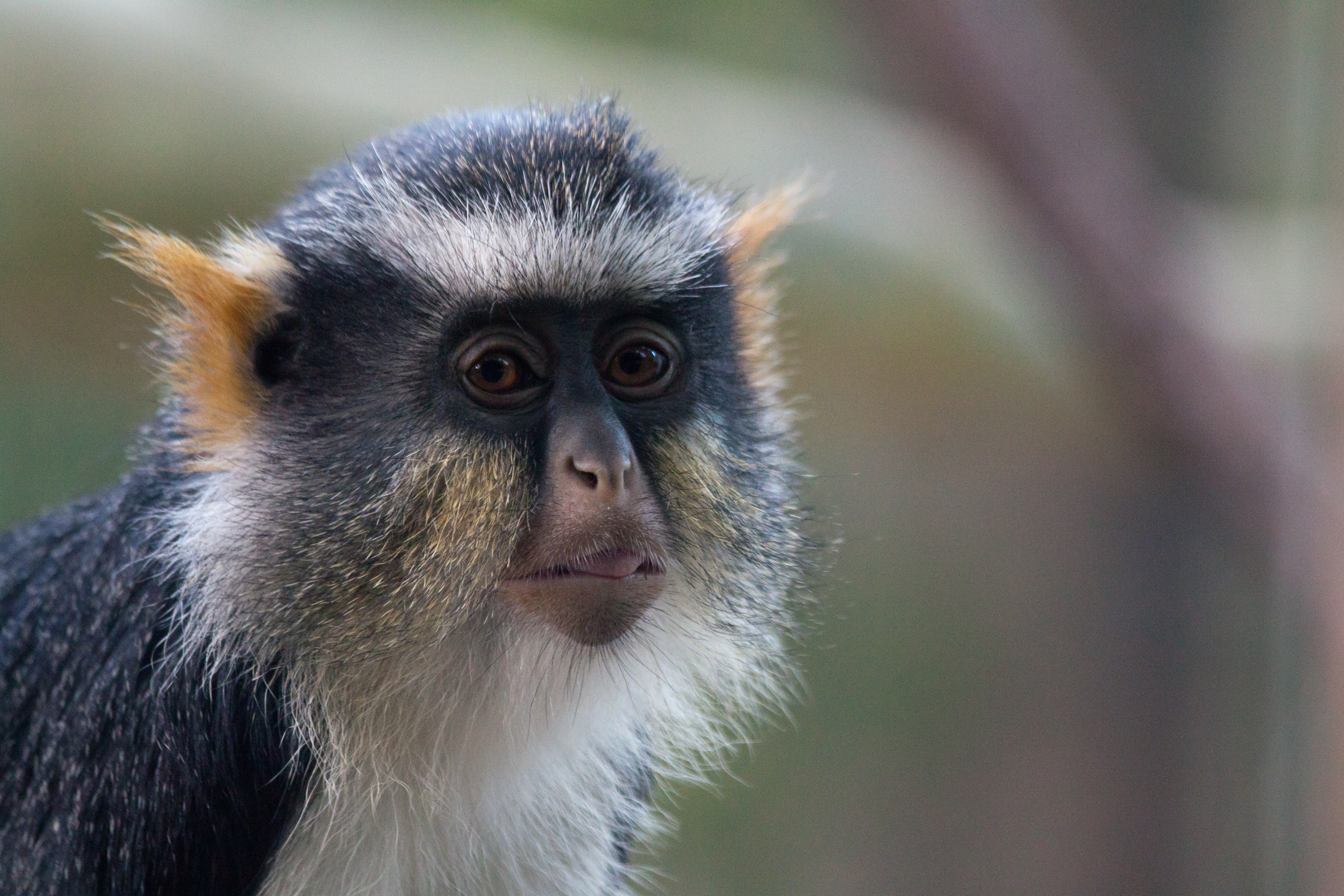 Old World · Wolf’s guenon
There are exceptions too: golden snub-nosed monkeys have extremely flattened noses with forward-facing nostrils. Reduced exposure to frostbite has been suggested as an explanation, but that isn’t the same as knowing for certain. The point isn’t that noses have no purpose. It’s that a feature can tell us about ancestry even when the reason for its particular shape isn’t obvious.
It’s not even body size that interests me most, because people can already picture a gorilla compared with a typical forest monkey. It’s more the actual structure of a baboon’s body, its pronounced face and how its proportions differ. Size is an easy thing to understand. Why they have such different structures relative to their bodies is the harder part.
I assumed baboons chased land animals and had fierce predators to deal with, hence their stocky builds and big teeth. Whereas gibbons are in the trees, so I assumed they ate fruit and relied more on agility.
With baboons, they look so scary—and that appearance can itself play a part in their social lives. Finding out that a hamadryas baboon’s diet is mostly plants is surprising when you look at its stocky build and massive canines. Those teeth can be used in threat displays as well as actual fighting. They don’t simply tell us that we’re looking at a hunter. Even fruit-eating gibbons can have long, dagger-like canines.
It reminds me of the atlas moth, whose wingtips resemble snake heads. Whether that resemblance functions as snake mimicry is debated, but the possibility is fascinating. Does the moth need to know it resembles a snake for the resemblance to help it? No.
If an inherited variation helps its bearers survive and reproduce, it can become more common over generations. It reminds me of the programming saying: if it works, don’t touch it. Evolution doesn’t literally stop changing things, but an animal doesn’t need to understand why a feature works for it to be useful.
With gibbons, their long arms, hook-like hands and mobile shoulders help them swing beneath branches, a movement called brachiation. Gibbons are apes, like orangutans, chimpanzees, bonobos and ourselves, so this takes us beyond the Old World and New World monkey distinction. We’re more closely related to the branch containing gibbons—no pun intended—than to baboons, even though we share the baboon’s largely ground-based existence. You might expect that shared way of living to mean we’re closer to them.
When I hear a gibbon calling, its vocalisations are almost chaotically angelic. It’s a whooping, almost robotic bird call, chaotic yet gentler than the typical “ooh ooh, ahh ahh” grunting I associate with primates.
Their songs help them communicate through forests. Pairs can sing together, and their songs help advertise their territory and maintain their bond. But what interests me most is the sound itself. It’s just so cool that animals we group together can sound so different.
It makes me curious about how such different animals share ancestry, and how their surroundings helped shape their bodies. My first thought is changes in their food, because that’s something the environment influences. But then comes the question of their minds.
Intelligence itself needs an evolutionary explanation. It isn’t a magic external source that reveals itself to a select few. We often take it for granted because we only see it through having it. But if our capacities developed through evolution, they have a history. Intelligence isn’t simply an on-and-off switch.
Finding food might involve sophisticated pattern recognition. Tool use raises further questions about what an animal understands, but neither automatically tells us whether it is conscious. Intelligence is multifaceted. Emotions add another question: what does an animal experience about its needs, and what does it understand about those experiences?
What interests me about adaptability is that the mind can change its approach without the body having to change its shape. An animal can learn a different response to a problem within its lifetime.
Even as humans, we find relationships difficult to navigate. Knowing whom to trust, whom to approach and when to back down involves so many changing factors. It makes me wonder how much of this is recognising patterns, and how much involves understanding another mind.
People often talk about animals knowing language. But if an animal learns that a sign or button produces food, that alone doesn’t mean it understands English. It reminds me of Searle’s Chinese Room: a man follows rules to respond to papers written in Chinese without understanding the language. The thought experiment questions whether producing an appropriate answer necessarily means understanding it. It doesn’t settle what animals understand, but it helps explain the distinction I’m trying to make.
The same question has to apply to social behaviour. Predicting a threat might involve recognising a familiar pattern. Some experiments suggest great apes can respond to another individual’s mistaken belief, which goes further than simply reacting to a threatening face. But working out what that reveals about their minds is difficult. Understanding something about another individual also doesn’t automatically establish reflective awareness of oneself.
That’s why I’m interested in bonobos being viewed as more tolerant than chimpanzees, even though both have complex cognitive abilities. Intelligence alone can’t explain why their social lives differ. What accounts for the difference? Is it their environment, their relationships, or how those things interact?
Female alliances are important in bonobo society, and research links more frequent coalitions with greater female power over males. Food distribution is one proposed influence on opportunities for females to associate, but that doesn’t establish a complete explanation of how these differences evolved. Nor is the comparison absolute: feeding tolerance varies between groups, with some chimpanzee groups more tolerant than some bonobo groups.
It’s so cool—and makes our own history feel so contingent—that differences in the conditions animals live under could help shape something as fascinating as their intelligence and social lives. How far does that take us towards understanding consciousness? I don’t know.
It’s interesting to imagine the transitional stages. As populations diverge across generations, at what stage do they become so different that we see them as distinct? It reminds me of replacing the wooden boards on an old ship: when does it become a new one? Evolution branches rather than simply replacing one thing with another, but the difficulty of finding a precise boundary still interests me.
I have a similar uncertainty about minds. Pattern recognition is part of our intelligence too, so perhaps asking when it becomes “genuine” intelligence already creates too sharp a divide. But how does understanding emerge, and at what point does an animal become aware of itself? I don’t know where those boundaries lie. That’s part of what makes these animals so interesting to me.