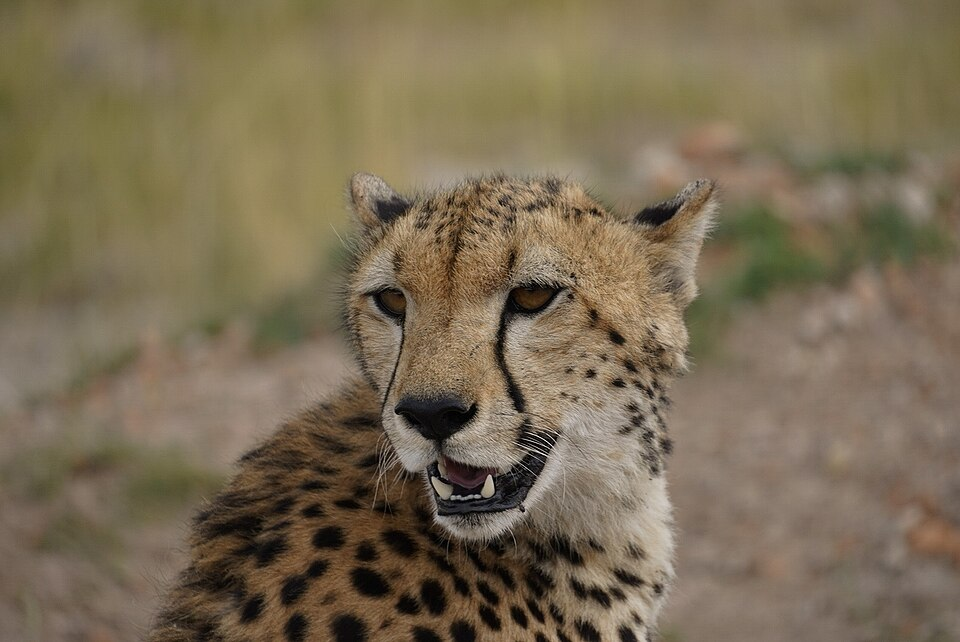
Everyone assumes big cats to be one in the same, dangerous, brutal, apex predators that could easily maul humans. However, the cheetah stands different - much more docile, with no reliably documented cases of a wild cheetah killing a human. If the lions, leopards, and jaguars are the big cats, Cheetahs are just a big small cat. An entire body built for speed and racing is fragile, they are meant to be nimble, and only a nervous disposition towards humans and other predators can protect such a fragile body.
Pharaohs kept cheetahs as hunting partners and companions, associating them with the feline god Mafdet, who could help Pharaohs reach the afterlife. Some early records show Sumerians in Mesopotamia using leashed and hooded animals interpreted as cheetahs. They likely used them for a practice known as coursing, where hooded cheetahs were released to chase prey like antelopes.
Cheetahs are known for their much calmer, more docile nature, as mentioned, compared to lions or tigers. Cheetahs were also controlled using hoods, similar to hunting falcons, to reduce visual stimulation and keep them calm. Some handlers used harsh methods of control, but this was still only taming.
In the past, there have been many recorded cheetahs being tamed and kept by royalty. However, taming, which is an animal's relationship with humans, is not the same as domestication, which is genetic selective breeding.
Taming changes an animal’s relationship with humans, but it does not change the species genetically. These cheetahs could be trained, handled and used for hunting, but they were not selectively bred over generations. Therefore, they remained wild animals that had been taught to tolerate human control, rather than a domesticated species.
For a long time, zookeepers and scientists attempted to breed cheetahs in captivity, expecting them to reproduce under controlled conditions. There was adequate food, shelter, water, and mates; however, breeding remained unexpectedly difficult and unreliable. Why?
When scientists analysed cheetah sperm under a microscope, it appeared extremely malformed, known as a condition called teratospermia. Tails were missing, heads were missing their protective cap or were too small, and midpieces were completely malformed. All in all, it was extremely hard for a sperm to reach and fertilise the egg. Biology was working against its adaptations.
If we take the average household cat, also in the taxonomic subfamily Felinae, cheetah sperm is vastly inferior in quality. This helped researchers understand how truly damaged it was relative to a domesticated comparison.
Modern cheetahs carry biological malformations that may have been fixed into their genomes by an ancient bottleneck thousands of years ago. The population crisis did not just reduce their numbers; it left a genetic mark that can still be seen in their reproductive cells today.
An ancient population crash in cheetah populations left survivors closely related, and so descendants remained with very little genetic variation. Descendants inherited the same alleles from either parent, which spiked homozygosity (having two identical copies of a gene). Due to this homozygosity, harmful recessive alleles, which should have been masked by dominant alleles in genetically diverse populations, were more likely to be expressed. This contributed to inbreeding depression, increasing the risk of lower fertility rates, weaker immune systems and a reproductive system that became much more inefficient.
Dogs are so familiar to us, in our households, on our walks that we forget they descended from ancient wolf populations. We have forgotten how complex domestication is; the actual long process that took place is often, at most, taken at surface-level comprehension.
Cheetahs are tolerant enough to tame, but their genetic history made domestication far more difficult.
Perhaps cheetahs could have been by our sides like dogs, if it were not for the ancient bottleneck of cheetah populations that produced genetic homogeneity.
We shall never truly know what a domesticated cheetah could look like.